Product Features
Flicker-Free Studio Lighting: What TLCI, CRI and R9 Mean for Camera Work
Why cameras see flicker that eyes miss — and how to read TLCI, CRI, R9, TM30 and dimming specs before ordering studio LED fixtures.
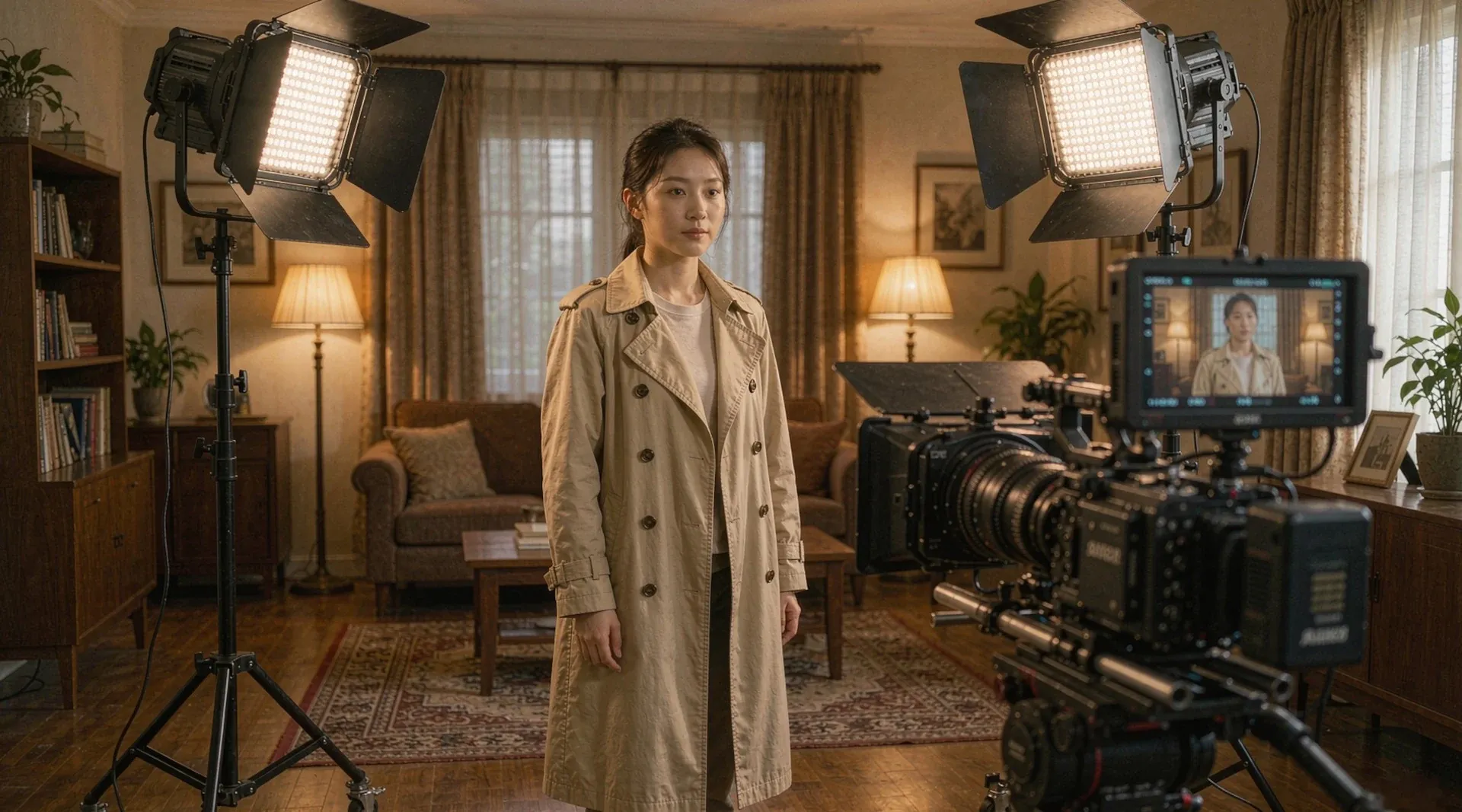
A light source can look perfectly bright to the eye and still ruin the shot. Rolling scan lines, colour shift and visible flicker appear the moment a camera — not a person — looks at the fixture. That gap between human vision and camera sensors is why broadcast studios, film crews and live-streaming rooms evaluate LED fixtures with camera-specific metrics before they buy.
What flicker actually is
LED fixtures regulate brightness by switching their drive current at high frequency. When the switching frequency or dimming method is poorly designed, the light output pulses. Human eyes barely notice it, but camera sensors sample frames at fixed intervals — so the pulses become banding bars, exposure wobble or colour drift on record. HEYI studio fixtures use constant-current driving with an anti-interference ARM7 processor and 0-100% smooth linear dimming, keeping output stable across frame rates and shutter angles.
Reading the numbers: TLCI, CRI, R9 and beyond
CRI (Ra) measures how faithfully a source renders object colours in general — HEYI profile and panel series deliver CRI≥95 to ≥97. R9 measures deep red rendering specifically, critical for skin tones; HEYI Fresnel series specifies R9>93. TLCI (Television Lighting Consistency Index) goes further: it models how a broadcast camera — not the human eye — perceives colour, which is why studio-grade fixtures target TLCI≥95 to ≥98. Beyond these, TM30 Rf/Rg (fidelity and gamut, up to Rf≥97 and Rg≥100 on HEYI panels), CQS≥96-97 and RG0 blue-light hazard rating complete a camera-friendly specification sheet.
Dimming design matters as much as the LED
A fixture can carry excellent LEDs and still strobe on camera if its dimming curve is crude. Look for: flicker-free linear dimming from 0-100%, an adjustable dimming frequency (HEYI supports 1.2K-32K to match different shutter setups), multiple dimming curves for camera matching, and a strobe range (1-25 flashes per second) that stays clean when effects are needed.
A buyer's verification checklist
Before you commit to a studio fixture order: ask for the photometric report, confirm TLCI and R9 numbers (not just CRI), test the fixture against your actual camera at the shutter angles you shoot, and dim to 10% — the point where cheap drivers usually reveal flicker. Lifespan matters too: HEYI specifies over 50,000 hours of LED source life under normal working conditions.
Want photometry reports or a sample unit to test with your own camera? Send a request through our contact page — our team replies within one business day. MOQ is 1 piece and samples ship in 3-5 days.